
Organizations know change will be disruptive. Yet time after time, disruption still damages productivity, performance and momentum.
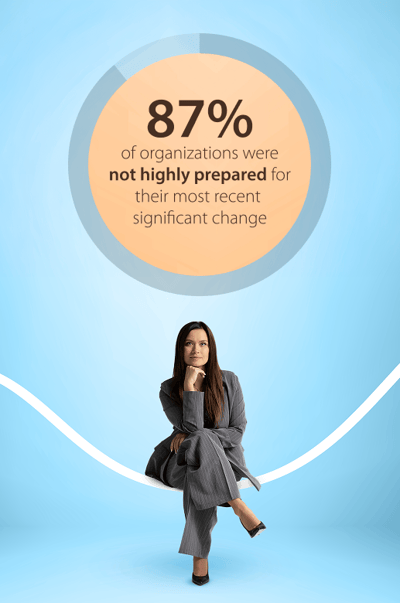
Everyone saw it coming. That didn't help
If there's one lesson from our new global research, it's that anticipating disruption is not the same as being ready for it.
Significant organizational change is now a regular feature of organisational life. Half of organizations experience it every two to three years, and across the global sample the average interval between major changes was 3.2 years.
Organizations around the world have learned the same reflex: identify the change, forecast the disruption and set expectations.
In fact, 77% of leaders said their organization anticipated at least minor disruption before their most recent significant change.
Most leaders are not complacent. However, the research suggests they often underestimate the scale of disruption. While only 39% anticipated moderate or major disruption, 51% ultimately experienced disruption at the organizational level.
As Justin Kinnear, Head of Research at HPC, puts it:
We overestimate our capability and underestimate the level of disruption.
Conventional wisdom suggests that if leaders could predict disruption more accurately, they would be better protected from its impact.
The data suggests otherwise.
We found little meaningful difference in productivity outcomes between organizations that anticipated major disruption and those that anticipated very little. Prediction alone did not appear to influence performance outcomes.
Expectation had remarkably little bearing on what happened next.
What was associated with stronger outcomes was the depth and breadth of preparation.
Pinpointing the right way to prepare
It seems obvious that preparation should improve productivity. Our research turns that assumption into evidence.
Organizations that prepared more comprehensively were significantly more likely to report productivity improvements during change. Among the most prepared organisations, 77% saw productivity increase, compared with 53% of the least prepared.
The least prepared organizations were also 2.2 times more likely to experience productivity decline.
The message is clear: more comprehensive preparation is associated with stronger outcomes.
But what kind of preparation matters most?
Our research identified six common preparation activities undertaken before significant organizational change.
Employee engagement planning sits at the top of the list, undertaken by 48% of organizations.
That makes sense. Leaders need to bring people with them, build buy-in, address concerns and help employees understand what is changing.
All of that matters.
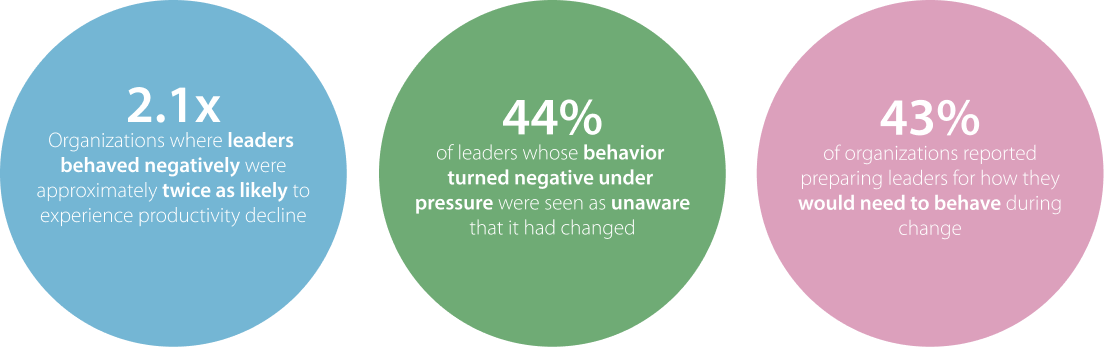
But the least common preparation activity in the study was one that may prove just as important: behavioral leadership preparation.
Only 43% of organizations reported preparing leaders for how they would need to behave during change.
That matters because change does not simply test structures, systems and processes. It puts pressure on leadership behavior, decision-making, relationships and team dynamics.
A useful analogy comes from sport.
You don't become ready for tougher opposition simply by talking about the game. Readiness requires preparation and practice.
As organizational psychologist Dr Rob McKenna says:
My wife and I both need practice. But when you go to the court, you don't want to drill. You just want to play. So we never get better.
Employee engagement helps people understand the journey.
Behavioral preparation helps leaders and teams navigate it when the pressure arrives.
It supports the ability to stay clear, consistent and constructive when uncertainty increases, priorities shift and tensions rise.
That's a very different capability.
And it may be one of the most overlooked elements of change readiness today.
Bridging the behavioral readiness gap
Maintaining productivity through change is not achieved through forecasting alone. Nor is it achieved through employee engagement planning alone.
It requires something deeper: behavioral readiness.
Behavioral readiness is the ability of leaders and teams to remain clear, consistent and constructive when change creates pressure.
The findings from our new research suggest that organizations often prepare extensively for what will change, while investing less time preparing for how people will respond to it.
That is the behavioral readiness gap.
The Global Change Readiness Report 2026 puts a number on that gap and explores what separates the organizations that maintain performance from those that struggle.
Ultimately, strategy sets direction. Structure redraws the reporting lines. Behavior decides whether change lands.
Get the full report today
The Global Change Readiness Report 2026 brings together insights from 880 senior HR and people leaders across 11 markets, uncovering the behavioral factors associated with stronger productivity, better leadership outcomes and greater resilience during significant organizational change.
Inside the report you'll discover: