
Personal development

Read first, speak last: Negotiate better with color energies

The ability to negotiate is a critical skill in our working lives. We negotiate daily, whether it’s to secure resources, coordinate project responsibilities or progress our careers. How good we are at it depends on our adaptability and a great deal on personality.

Yet often, we aren’t aware of how our personality traits shape our negotiation style. Worse still, we may not be recognize how our counterparts prefer to approach things.  We wonder why we’re not getting through to the other person.

Even worse, our default negotiation style might be precisely the wrong approach for the person we’re negotiating with.

At Insights, we know it's often a matter of perception, and the same message delivered in different ways can produce entirely different responses. It pays to understand who you’re talking to and learn how to speak their language


Before you begin: Know what your counterpart values most

Students of negotiation or mediation strategies will be familiar with the Harvard-developed Mutual Gains Approach. But if you’re catching up, the basic premise is that it rarely works to take a rigid, positional “I need X” approach to negotiating settlements.

Positional bargaining leads to a frustrating zero-sum game, and even when a compromise is reached, some needs may remain unmet, and some parties may remain unhappy. 

In contrast, interest-based negotiation works better. Negotiation isn’t all about winning at zero cost or compromising; it’s about understanding what’s driving the other party. Chances are, each party -including you- will have different motivators, so you can creatively build offers that will satisfy their motivations and values, while still satisfying your own.

We often see this style of negotiation in recruitment: A candidate is motivated by freedom and asks for a higher salary (perceiving the salary as a means to freedom). The company is already at the top of its hiring budget; it is at an impasse. After a few conversations, the hiring manager instead offers additional vacation days and flexible working. This meets the hire's motivation for more freedom and the hiring manager's motivation to stay within the budget. Everyone feels they 'won' in the negotiation. 

In Mutual Gains, we take the time to understand ourselves and to understand others.  Awareness of what others value is critical and one does not negotiate without it. 


Are you willing to speak their language?

It's not just what you say (Mutual Gains), it's also how you say it. 

Once you understand what others value, it's important to adapt how you communicate your ideas to align with your counterpart's preferred communication style. 

Once again, awareness is key.

It's important to understand your natural communication style and what you most value. Action vs accuracy. Speed vs caution. Within that context, you can look at the other party's communication style. Do they prefer action or accuracy? Do they prefer speed or caution?

For example, you may look at:

  • What energizes them or drains them
  • Do they typically present with lots of detail or employ more of a need-to-know style
  • Understand what organizational politics, budget constraints, or external pressures they may be facing
  • Are they all about data, relationships or super-fast results
  • How does their personality type experience your personality type? (Do you tend to energize them or alienate them?)
You might have to be resourceful and observe their work, consult others or scan their Insights Discovery profiles if you don’t already work with them. In an ideal world, you’ll know their Insights Discovery leading color energy and can use it as a jumping-off point (but we’ll come back to that).


Flex! Adapt your language and tone to ensure resonance and trust

 When you first meet, don’t just leap in. Read the room. There’s a fine line between solid substance and feel-good buzzwords, and that line shifts with every personality type. You still need to sell your idea, of course, but even with your prep done, working out what actually lands with different people can be trickier than it looks. This is where Insights will help. 

Using the Insight Discovery color energy model as our guide, we can adapt our presentation based on a communication style that's likely to resonate with the other person. 
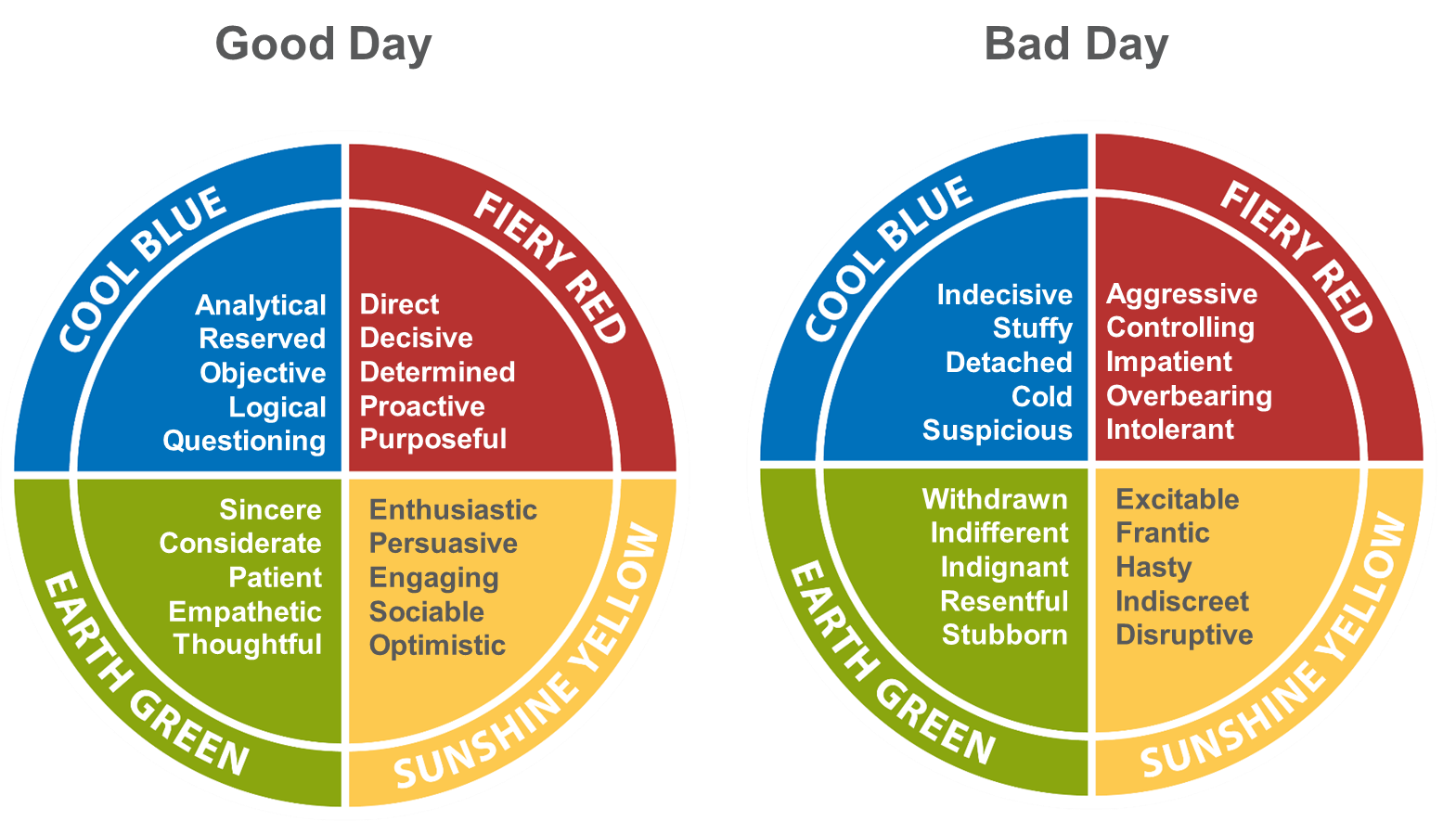
 

Colour wheel 2026


Cool Blue: Provide data, accuracy and avoid long tangents

When negotiating with colleagues who lead with Cool Blue color energy, facts and logic are paramount.

Often analytical and detail-oriented, they may thrive on evidence, process and structure.  

Generally, Cool Blue doesn't rush into decisions, preferring to reflect and ask questions.

Don't be thrown by lots of questions; Cool Blue often needs to feel confident things are accurate before they will consider them. 

  • Present your information in a structured, logical way. Come prepared with data and evidence to support your case
  • Use written communication and provide detailed documentation before and after conversations
  • Be ready to answer detailed technical questions and “what ifs.” Digging deeper and pre-empting problems can be a natural part of their decision-making, and they're unlikely to lose their thread if you get detailed
  • Ask them questions as well -it helps balance the power dynamic
  • Avoid being embellishment, appearing emotional or using platitudes to summarize situations; this may irritate
  • Don’t gloss over issues, omit important details or introduce unexpected changes in the moment
  • Provide space for them to analyze your points and the data. Cool Blue rarely make decisions on the spot, preferring to process first

Fiery Red: Be assertive, direct and focus on outcomes

These colleagues may be fast-moving and results-driven. They’re often motivated by goals, may be data-led, and often want to get straight to the point, possibly controlling the conversation from the outset.

They may try to interrupt, overlook your points or rush you into a decision.

  • Be brief, task-focused, clear and concise. Avoid small talk and focus on tangible outcomes.
  • Know that you don’t have to match their feistiness – you too can control the pace of the conversation and set boundaries
  • Get to the point. Use clear headlines, sections and bullet points if written formats are involved
  • Focus on how your proposal helps them achieve their objectives quickly, as well as mutual gains
  • Show that you respect their time. Come with clear options and a recommended path forward.
  • Avoid appearing indecisive or unprepared, or getting lost in detail or lengthy explanations
  • Don't mistake their directness for rudeness. They simply prefer efficiency over politeness.


Earth Green: Keep it human and focus on relationships

Colleagues who lead with Earth Green are typically empathetic and value harmonious relationships.

They are motivated by trust, shared values and a sense of inclusion.

In favor of quick results, they may focus on harmony over hard outcomes and aim to mediate disagreement. 

Alignment is critical; when proposals stray from Earth Greens'  core values, resistance tends to increase.

  • Be personable, patient, thorough, and show empathy.
  • Take the time to build trust and rapport, and demonstrate your interest in a fair outcome for all.
  • Use words like support, collaborate, and feel (authentically).
  • Avoid pressure. Allow ample time to consider the proposal and make a thoughtful decision.
  • Listen actively to their concerns and feelings, and hear all perspectives.
  • Highlight the values you both share—what your proposal reflects—and discuss the impact on people and relationships.
  • Avoid appearing insensitive or focused only on winning or speed—they may start to withdraw.
```

Sunshine Yellow: Create a collaborative, enthusiastic atmosphere

This personality type tends to be enthusiastic, sociable, creative and motivated by collaboration and possibilities.

Even in tense situations, be serious but personable. 

Specifics might not be their strong point, so keep an eye out for vagueness and be sure to request timelines, data and agreements in writing

  • Whatever the topic, build rapport and connection with them from the outset.
  • Avoid a rigid or overly formal communication style—even when discussing money. Keep it friendly and open.
  • Start with the big picture. Don’t get bogged down in detail too early; build up to it.
  • Be expressive and focus on how decisions affect people—keep it human, not just hard facts.
  • Don’t be purely transactional. Sunshine Yellow energy needs to trust you before trusting your proposal.
  • As they speak, distinguish friendliness from facts. Don’t confuse an agreeable nature with agreement.
  • Invest in the relationship—it can only help during the main discussion and is often meaningful to Sunshine Yellow. If you need to redirect small talk, do so gently.


If you both seem to share the same negotiation style, that’s a bonus, but make sure you leave with everything you need to progress. And sometimes, when progress falters, and the only thing you can agree on is a timeline, that’s still progress. After all, you can build on a timeline; it gives you a mutually agreed-on starting point.

Bottom line: The most effective negotiations leave each party feeling satisfied and willing to work together. It should be a case of ‘how can we solve this problem together’, not ‘how can I win this?’. Good luck!


Insights Discovery is an award-winning L&D training system that creates high-performing teams by awareness and workplace relationships. Using a memorable four-color model to illustrate different behavioral styles, it creates a common language that connects colleagues across geographical and cultural boundaries, fostering collaboration, driving productivity and transforming workplaces.

Learn more about yourself with Insights Discovery_970 x 254px-1