
Are you running effective online meetings? Do people turn up? Are cameras on? Is anyone listening? Do positive decisions get made and stuck to? Are you speaking into the void?
It’s definitely the era of rethinking how we collaborate at work, and bad meetings are at the top of many a manager’s list of gripes.
But let’s not be too hasty about getting rid of meetings altogether or relegating important connection opportunities to messaging or AI.
Good, productive online meetings can be a real lift on a heavy day and can be a saviour from social isolation if you work alone.
Even if the agenda isn’t riveting, it’s a chance to connect, debate ideas spontaneously and remind us that we’re brilliantly human.
Author and organisational behaviour expert Rebecca Hinds suggests that a good meeting is “a highly intentional meeting—intentionally scheduled, intentionally attended.” It leaves people feeling like they got a lot accomplished because they came together, and that the same outcome couldn’t have been achieved by an email.
It’s a great description.
But as we all know, meetings don’t always go to plan. Instead of feeling productive and energising, they drain and irritate us.
Half the team is on mute when you need them not to be, cameras fail, or there’s distracting background noise. By the time your meeting has properly kicked off, people’s energy has already dipped, and keeping things focused feels like an uphill battle for the host.
It’s not just you...
Fact: Virtual calls require more eye contact, less physical movement (not ideal for creative thinking) and increased self-consciousness. As well as the unavoidable tech delay that causes us to talk over each other, we ‘re subject to lack of non-verbal clues and cues like body language, tone and facial expressions. Our brains work overtime to fill in the gaps.
What makes a great virtual meeting? Your quick-guide
With enough self-awareness and audience awareness, hosting (and experiencing) good online meetings is possible.
One size never fits all… know your audience!
One of the most common denominators in the ‘meetings we prefer to avoid’ is a lack of awareness of different preferred communication and problem-solving styles.
If virtual meeting hosts tune into the contrasting needs of the personality types they’ve asked to come together, meetings are more productive and less draining. In smaller meetings especially, where it’s likely that everyone will make an active contribution, it helps to think about your colleagues’ typical working preferences and communication styles in advance. Are they mostly Thinkers or Feelers?(Link to Teams App blog)
To get the best from people and shape the conversation better, consider who brings what. Are you hosting a group containing reflective introverts, or louder extroverts who dominate, or data and fact-lovers/uber-questioners, or easily distracted anecdote and chat-fans?
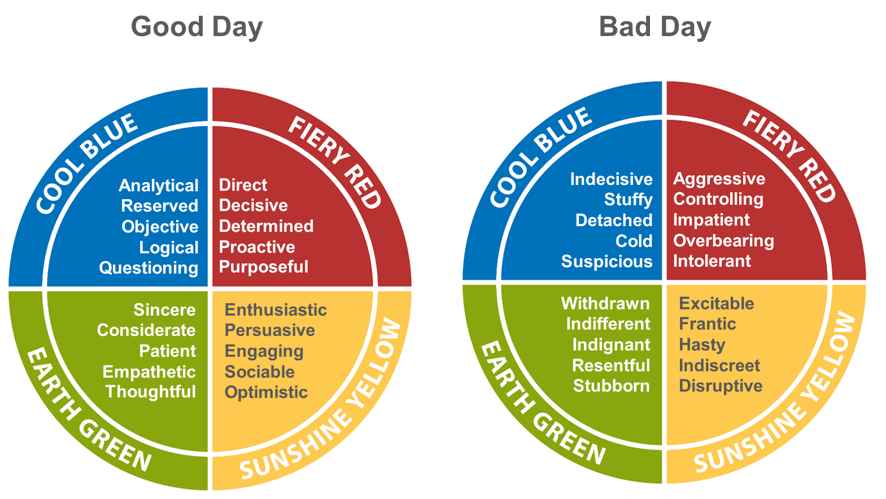
You can’t please everyone, but it really pays to dial up this ‘audience awareness’. What motivates particular individuals, what are their stress triggers are and how might you appeal to their values at work? This is where awareness of the Insights Discovery model and its four main personality types can make a significant difference.
Some people value spontaneity over structure, others value brainstorming over combing through process and data. You’ve met them all!
Clearly, the best approach depends on the reason for the meeting, but most meetings require a mix of sharing facts and reaching data-based decisions alongside lively ideas-sharing and creative thinking.
Using the Insights model, consider these common personality differences in your next meeting, whether you’re the host or a participant. You’ll find that understanding others becomes easier, friction is less likely and differences of opinion can be navigated in a less judgmental, less ‘right or wrong’ way. Being more open to your colleagues’ different values does help.
Cool Blue: This colleague appreciates a meeting with structure, order, logic and enough detail to make important decisions and plans. The ‘why’, ‘how’ and the ‘what next’ are paramount.
Consequence: They may appear to slow progress down in their quest for accuracy and clarity
Fiery Red: Less keen on detail in this setting and more concerned with goals, pace, momentum and accountability. This colleague will keep things moving and finish on time.
Consequence: They may appear impatient, blunt and dismissive of others’ need for consultation, ideas-sharing or detail clarification
Sunshine Yellow: For this colleague, meetings are for collaborating, ideas-sharing and connecting. They’re open to spontaneity, creative tangents, anecdotes and big picture thinking.
Consequence: They won’t relish an inflexible agenda, combing over details or being ‘reigned in’.
Earth Green: Team harmony, consensus, feedback and human impact are important to this colleague. They want everyone there to be listened to, properly heard and understood.
Consequence: They may resist being rushed into decisions and will steer away from conflict
Machines aren’t the answer…
No matter how much you love AI, try to resist sending a robot to the meeting in your place. It might be great for fact-gathering and time-saving, but it won’t help you build relationships or tune into sensitive developments that affect your team and project. Let’s keep it real; let's keep it human.
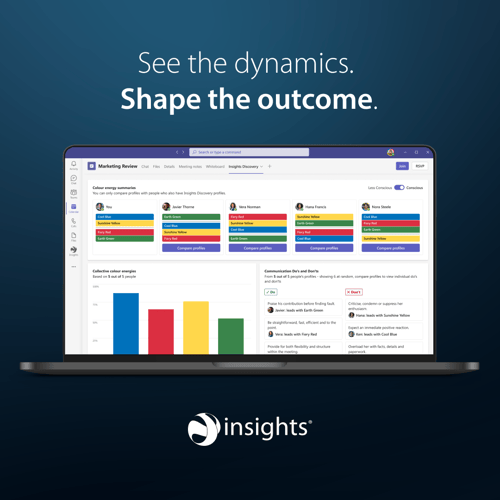
Insights Discovery for Microsoft Teams is your instant communications coach to help every person on your team connect and perform better, right where work happens. Bring award-winning Insights Discovery profile data to life inside Microsoft Teams, and let the language of Insights colour energies empower your team to communicate with confidence.