

A popular study from the University of Queensland highlights that being seen as an authentic leader takes more than knowing yourself. To gain support, leaders need to show that they understand both who they are as individuals and how they belong to the group they lead.
Acquiring awareness isn’t easy, yet decades in the field have taught us that the exercise is not only important, it’s critical for leaders to transform from reactive and task-focused to strategic and visionary if they’re to succeed.
Self-aware leaders carry significant advantages that enable them to navigate different kinds of environments and situations with confidence and ease:
- They incorporate self-knowledge into their development plans, empowering them to reach their goals
- They identify what they need to change about their approach to influence the success of the team and the organization
- They have a greater sense of purpose about why and how they’re leading their team or organization
Dr Tasha Eurich’s ground breaking research in the field found that only 15% of people demonstrated true self-awareness, yet 85% of the people asked in the same survey felt there were self-aware!
That means there’s tremendous blindspots room for growth in this area.
Most leaders come to the table with a good understanding of their likes, dislikes, what they value in life and what they’d like to achieve (or perhaps only 15% of them, keeping Dr Eurich in mind). This is a good start, yet navigating the gap between reactive and visionary leadership requires understanding yourself on a deeper level.
Along with self-awareness, organizational psychologist, Dr Tanya Boyd (Insights Discovery Learning Architect), refers to a second important type of awareness for leaders which is other-awareness, or awareness of the strengths, challenges, hopes, fears, and dreams of those around you.
Both sides of this awareness coin, self and other awareness, are equally important to leadership success.
Explore how Insights leadership development solution helps turn
awareness into practical actions.
How to gain awareness of yourself and others

At Insights, we use a four-color model to help you understand yourself and others.
The four colors or ‘energies’ have distinct characteristics that represent your most natural ways of behaving. Everyone has a preferred mix of all four colors; it’s this mix that creates your unique personality, and influences how you react to certain people, situations and challenges.
Good day
|
Bad day
|


The four color energies give you a simple language to describe your behavior, and this helps you and your colleagues understand why you do the things you do.
In the case of a reactive workplace, for example, consider how it feels to jump from fire to fire throughout the day.
Those who lead with Fiery Red energy may feel exhilarated by the constant challenge, while those with strong Cool Blue energy may feel drained and uncomfortable.
Once you understand this, you can begin to adapt your behavior.
For example, a manager who prefers Cool Blue energy, in understanding her need to act cautiously, deliberately and with precision, may want to study a set of data thoroughly before making a decision.
She can address that need openly with colleagues, giving her the opportunity to review important details before moving forward. This may clear a bit of space in her mind, so that when in-the-moment questions are asked, she’ll be better prepared and able to make quick decisions (though this may not feel as natural for her and therefore require more mental effort).
As a leader, it’s important to understand how you show up to those you lead, and the language of color can provide an effective starting point.
Self-awareness in action
Take the example of Shane Murphy Goldsmith, President and CEO of Liberty Hill Foundation in Los Angeles.
Shane engaged Insights to deliver Insights Discovery to the team at Liberty Hill, starting with herself (Insights Discovery is Insights’ flagship program where we first introduce the four color energies).
The Insights Discovery personal profile uncovers which color energies you prefer to use and how your behavioral preferences come across to those around you.
Shane’s initial reaction to her profile was defensive: it revealed that, with her strong preference for Fiery Red energy, there were times when Shane came across to others as harsh, overbearing and cold, and with high expectations.
Obviously not how she was intending to show up to her team, and far from how she thought she was showing up.
The most revelatory moment was when I did an exercise with my team, and we all put a post-it on each other’s back and indicated what color we thought people led with. Most people gave me Fiery Red, and I couldn’t believe they knew this about me, and I didn’t. These people work with me every day and they know me. Having this perspective, I took it more seriously and, once I looked at it with more open-mindedness, I could see the whole picture about how I was showing up.
Shane’s experience is not unique, and it was because she had the courage to embrace the reality of how her behavior was impacting her environment that she was able to change herself and her environment for the better.
Discover your color energy preferences
Take a look at the color energy wheel and the bullet points below. Which color energies do you relate to most strongly?
Accepting how others may perceive you in the workplace will help you consider how others are showing up too, so you can better adapt your responses.
Viewing your workplace colleagues through the lens of the color energies

We can’t always change the issues that arise in the office, but we can certainly reduce the amount of chaos, stress and miscommunication that can occur between people.
This level of awareness, and the mutual understanding it generates, is what fuels breakthroughs when you’re fighting those fires. This is why self-awareness is the most important factor in becoming a visionary leader.
Exercise: Which color energy best reflects how you act on a good day and on a bad day?
- Looking at the Insights Discovery color energy wheel again, which primary and secondary behaviors do you feel best describe how you are on a good day and on a bad day?
- Now show the diagram to your colleagues. Ask them which primary and secondary behaviors they feel best describe you on a good day and on a bad day.
Good day
|
Bad day
|
How to integrate your self-awareness into a leadership model
Becoming a visionary leader means bringing the four manifestations of leadership into balance. Now that you’re aware of your color energies, let’s look at how these color energies interact with different leadership styles.
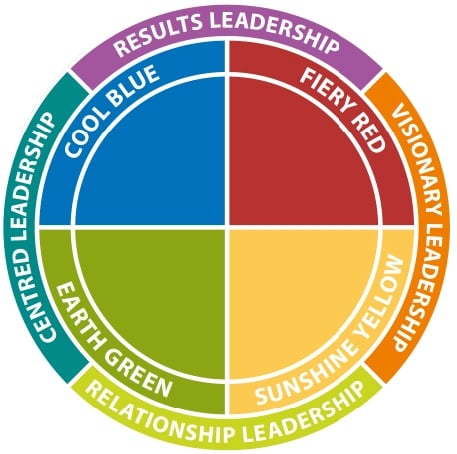
The four leadership manifestations are:
How to apply this awareness and change how you lead in your daily work life
We said earlier that everyone has a unique mix of all four color energies, and the same is true for all four leadership manifestations.
Although knowing how we prefer to react and show up are useful tools in themselves, the real value, from a day-to-day leadership perspective, is knowing how to balance opposite styles when leading. In this way, we become skilled at switching between them as the situation warrants.
Discover your development opportunities and expand your repertoire
This simple exercise will reveal to which extent you rely on one leadership manifestation over another and focus your development in areas you need to work on.
-
In the first row, write the percentage of time you spend in each area. All four areas should add up to 100.
-
In the second row, write the percentage of time you’d like to spend in each area. All four areas should add up to 100.
-
Identify the manifestation that has the largest growth opportunity – this is your mission-critical priority.

The leadership manifestation with the largest gap is your mission-critical development priority.
The leadership manifestation with the second largest gap is your next priority.
Looking at your own chart, which leadership styles do you need to develop or tone down?
We’ve collected a of series stretch tasks you can practice for all four leadership manifestations. Even integrating one or two targeted stretch tasks into your daily life can make a marked difference in how you lead, how you’re perceived, and how you perceive others...
