

Self-awareness helps us eliminate blind spots and raise team performance. Can it really lead to measurable results?
Consider: How wide is the gap between who you think you are and how others actually experience you?
It’s a great question. We might be able to broadly describe our strengths and weaknesses as colleagues and communicators, but dig deeper and the real question is, what impact does your behaviour at work have on others and are you able to adapt it?
Self-awareness has two sides: there’s how well you understand yourself – your work-style preferences, your triggers, your strongest values – and then there’s how clearly you realise your impact on others.
Depending on your personality, you may not worry much about what other people think or be prepared to change how you behave, but it pays to be aware of it. If you’re a leader or manager, self-awareness is critical. It also helps us make better sense of difficult relationships.
But, like any skill, self-awareness may not come easily. It requires deliberate practice and reflection to develop. It’s important for all of us at work but even more so when others look to us for instruction, guidance and support.
Dr Tasha Eurich suggested over a decade ago that 95% of people believe they’re self-aware, yet only 10-15% actually are. That‘s a worrying gap between perception and reality.
What do self-aware people do better than 95% of people?
A lot of it comes down to one key action: They listen more than they talk.
They're curious about their own minds and reflect on how their values compare with those of their colleagues. They’re not afraid to ask for feedback don’t get defensive about what they hear.
In any personal development session, coming to terms with your deeply held values and preferences and realising how they affect your daily interactions with others can feel challenging. It can be confronting if you’ve never sought detailed feedback beyond the main points in an annual appraisal.
The ideal setting for these conversations is of course within a safe framework that offers a non-judgmental, common language to discuss your ‘findings’ with managers, mentors and colleagues. Insights Discovery is designed for this*. But, however you choose to do it, the important part is being open to what you find and being willing to work on it.
Becoming more self-aware means knowing your values and how they affect your decisions, your non-negotiables and how you respond to stressful situations. You learn whether you’re more of a logical, facts-led individual or someone who’s more driven by intuition and emotion. You may base most of your decisions on what’s always worked well before, or be happy to experiment for a ‘better’ outcome.
Zooming outwards, are you able to view your ‘opposite’ type objectively, without irritation or judgment? Blue-sky thinkers and granular thinkers need to find ways to co-exist calmly and comfortably at work, as do decisive, fast action-types with more reflective, consultative individuals.
What does lack of self-awareness look like at work?
Perhaps these sample workplace scenarios sound familiar. Most of us have experienced such colleagues, or maybe you recognise these traits in yourself but are unaware of how to change them...
Awareness is the first step in behavioural change
Being prepared to change our behaviour, once we’ve acknowledged our communication strengths and weaknesses, is vital.
Routinely acknowledging less-than-ideal workplace behaviour (like interrupting, micromanaging or missing deadlines) but never actually changing it, is not self-awareness.
We’ve all met (and we may ourselves sometimes be) the overly-direct communicator whose insensitivity causes offence, or the ‘apologiser’ who keeps on interrupting due to being ‘passionate’. Perhaps we’ve also met (or maybe been) the poor prioritiser who misses deadlines. Or the feedback-seeker who then argues with the feedback.
This type of acknowledgement is used as a shield to avoid genuine behavioural change. People often believe that because they've labelled the behaviour, they are self-aware, but they continue to cause the same team friction.
A truly self-aware person pairs recognition with specific, actionable change.
At Insights we like to talk about the importance of understanding blind spots - they’re an essential part of self-awareness. In the ‘interrupter’ example, the individual is completely missing the negative impact of their actions on team dynamics and others' ability to contribute.
How well do you build internal clarity?
Real self-awareness goes beyond knowing your strengths and recognising your preferences. It means knowing how others see you, recognising your blind spots (and how they affect others) and understanding how your behaviour changes outcomes, for better or for worse!
It’s important at work to know yourself and be at ease with expressing it. It means you can answer questions about your values and working preferences without hesitation. You acknowledge strengths and weaknesses, and when challenged, use them as a foundation for learning, rather than letting ego or fear take over.
As your awareness expands, you see the gaps. The difference is that you approach them with honesty and objectivity. Instead of slipping into self-criticism or denial, you treat them as opportunities for growth.
Looking outwards (seeing yourself through the eyes of others)
It’s important to understand the signals you give off, and why others experience you that way.
We all carry a picture of who we think we are, yet it rarely matches how our colleagues experience us. This gap shows up in both strengths and weaknesses.
Simple exercises, like asking colleagues to describe you in three words, can be eye-opening. They often highlight qualities we overlook or blind spots we don’t notice (or don’t want to acknowledge). When we recognise our blind spots, we see how our actions land with others.
With the right level of self-awareness, we can flex, pivot and adapt without losing our authentic self – we can adjust how we think, act and communicate to achieve better outcomes and better working relationships.
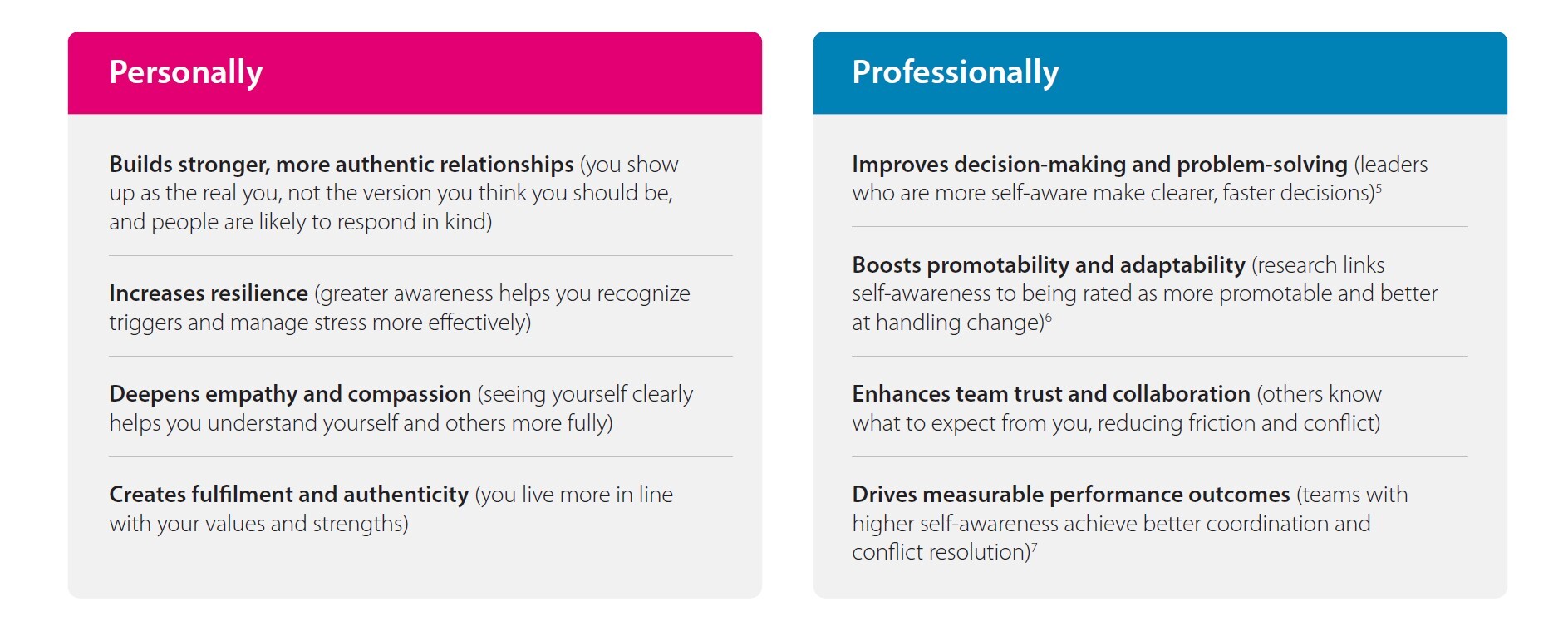
When we’re more self-aware and more others -aware, it enhances the level of trust in the team and so collaboration becomes easier. It certainly reduces the likelihood of friction and conflict.
What steps could your team take today to improve how you understand yourselves and your impact on others?
To learn more about the impact of awareness and how you can harness the awareness advantage in your own career, download The self-awareness gap: Why 95% of people get it wrong (and how to get it right)

