

The Chief Human Resource Officer has one of the toughest jobs in business, and several new reports suggest that the role needs more support, more understanding and more internal investment.
The role has reset dramatically, and it’s getting harder to define where it ends.
In the past, CHROs were seen primarily as operational leaders focused on recruitment, onboarding, performance and compliance.
Today, they’re strategic architects of the workforce and the culture; shaping leadership pipelines, guiding transformation, managing AI integration, designing hybrid work models and leading the employee experience at every level.
The ever-expanding demands of the CHRO role
Their influence now stretches from the boardroom to the front line. And with leadership itself under pressure to reset, CHROs play a critical dual role: developing the next generation of leaders while role-modelling the adaptability, empathy and balance that future leadership demands. 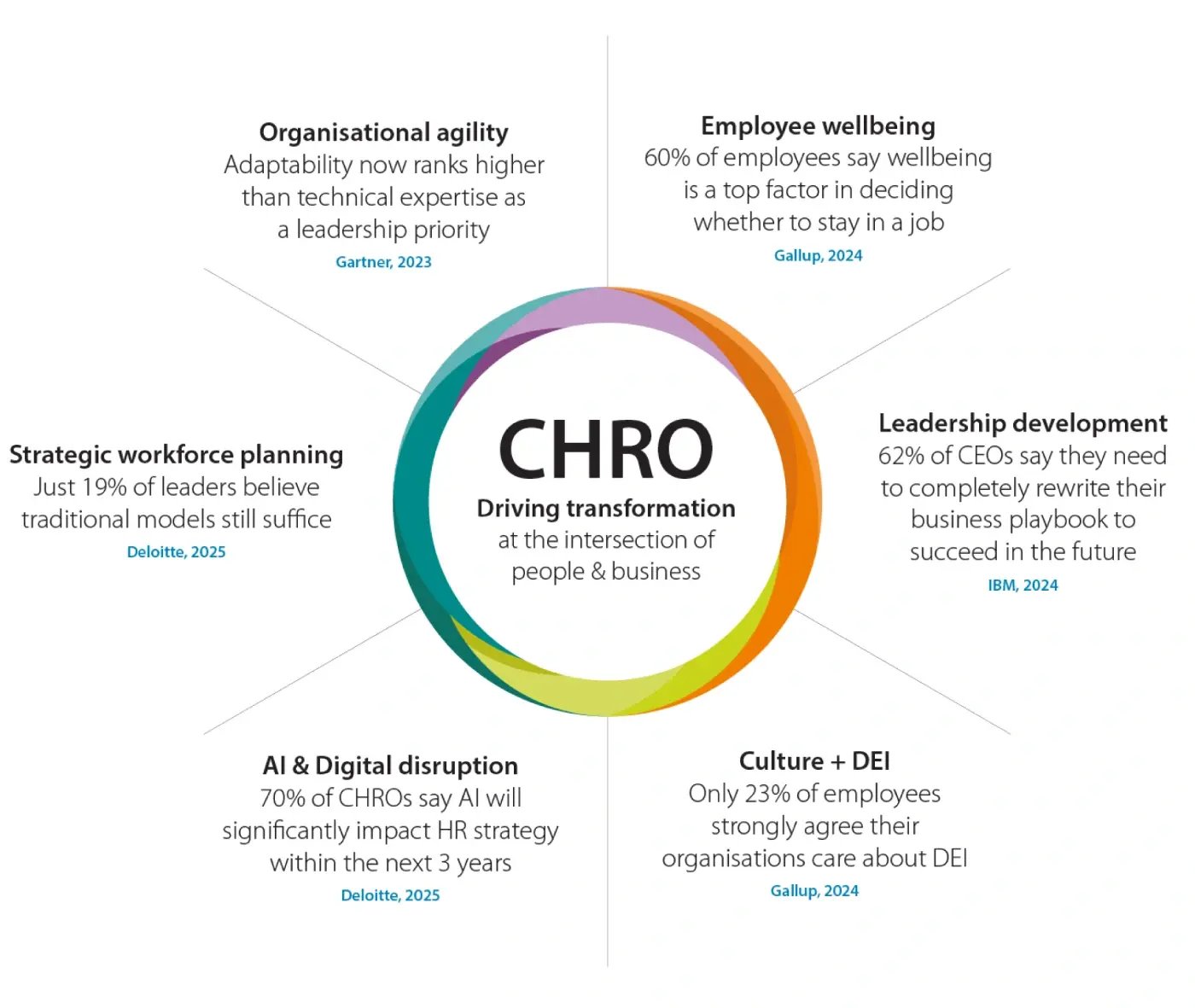
New skills are needed
To do all this well, and to cascade pivotal business decisions into every area of people management, CHROs must work closely with their CEOs.
Together, they need to understand where the company is heading, how the workforce is behaving, which legislative and political factors could have an impact, and as if that weren’t enough, be ready for sudden shocks like a global pandemic or financial crisis.
This requires strategic business expertise far beyond the original, more administrative HR function. Today's HR leaders are deeply embedded in business operations and strategy, not just people processes.
Of course, a fast-growing tech firm will have different requirements from its HR leader than a longstanding financial services organisation. Either way, the CHRO role is immense. It will continue to evolve and needs appropriate support and investment from the C-Suite.
And because CHROs are also central to shaping how leadership itself evolves inside organisations, boards must invest in their growth. To reduce CHRO burnout risk and enable them to thrive, they need ongoing opportunities for continuous learning, both in business strategy and HR, alongside access to coaching, mentoring and the right insights and data to guide their decisions.
It's a delicate balancing act!
As a recent Deloitte report suggests, today’s CHRO must be both a sharp business executive with strong commercial skills and a people expert. Striking that balance is difficult, efforts to improve one are often rewarded at the expense of the other.
The CHRO must somehow find a workable balance between nurturing human-focused skills (their own and their HR colleagues’) and business-focused skills.
Often, focusing more on business outcomes and business skills prioritises short term results. Great for shorter-term profit and shareholders; possibly not so good for workforce morale or sustainable talent retention.
On the other hand, investing in human skills and people-focused outcomes (especially with the rise of AI) tends to build more resilience, loyalty and sustainable value.
In reality, it’s rarely about outputs or efficiency. It's also about who is doing work and how best to help them do it well.
This means that developing human skills, from interpersonal and relationship-building to teamwork and leadership development, is not optional. Boards need to remember this includes supporting the CHRO themselves.
As Deloitte put it, “maximising human performance shouldn’t have to mean choosing workers over profit or profit over workers.”
Yet few organisations truly act on this. Gallup’s 2025 State of the Workplace report shows global engagement levels have fallen again. Even more concerning, Gartner’s CEO and Senior Business Executive survey revealed that “the workforce” slipped into fifth place on the list of CEO concerns, behind growth, technology, operating models and financial stability.
The current reality is that few organisations fully recognise the power of human motivation in improving business performance or take deliberate action to harness it.
This disconnect underscores the pressure on CHROs. The Josh Bersin Company’s Understanding the Path to CHRO report (2025), based on research with 47,000 global CHROs, highlights
The message is clear: organisations need to invest in developing their CHROs’ skills
Because, while their remit is vast, little of it will succeed without a deep understanding of the values and motivations of their people, including their peers at the C-Suite.
This isn’t new. Back in 2018, the then CHRO of KPMG Germany predicted that “HR should be helping to define a leadership culture that underpins the kind of values that people are looking for in a job, in the workplace. People want purpose in their work, and HR should take the initiative on the culture agenda. With increasing digitalisation and automation, people are becoming the decisive factor. The role of HR in driving engagement and an attractive leadership culture in which people can thrive is ever more urgent.”
The CHRO Toolkit: Skills for the Future
Where human performance is concerned, it starts with the CHRO
Now that the CHRO finally has a permanent seat at the board table, they must be supported to deliver on all fronts.
When C-suites prioritise human-focused skills, organisations are less likely to experience drops in workplace morale, retention or performance. Senior HR leaders know from experience how to spot early signs of disengagement, burnout, breakdowns in team trust and declining productivity.
That means equipping CHROs to mitigate these risks early, by helping colleagues communicate, understand one another and collaborate more effectively on values, purpose and motivation, alongside their core business priorities.
Get the human part right, and the business rewards will follow.
If you’re ready to equip your leaders with the self-awareness and adaptability the future demands, learn more about our Self-Aware Leader programme here