

Leadership development is no longer a ‘nice to have’, it’s a defining factor in organisational success.
As the pressure on leaders intensifies, companies are realising that strong requires deliberate investment, strategic focus and a shift away from outdated approaches.
The leadership reset is already visible in the numbers:
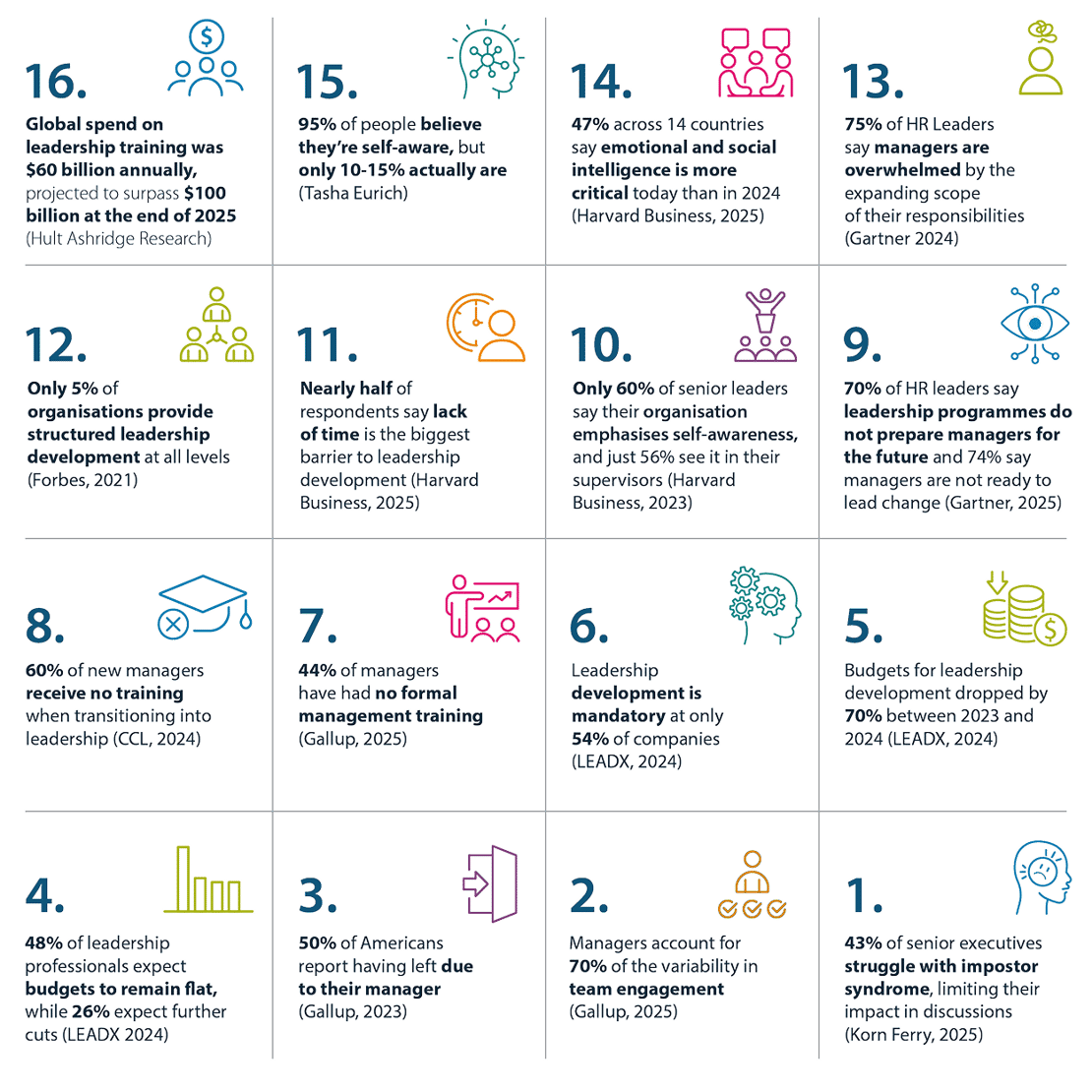
- Global spend on leadership development reached $60 billion annually and was projected to reach a global market value of over $100 billion by the end of 2025.
Leadership development has traditionally focused on hard business skills: decision-making, strategy, risk management and change leadership.
But today’s reality demands just as much attention on the human side of leadership: empathy, humility, inclusivity and the ability to adapt communication under pressure. These are no longer “soft skills”, they are the hardest to master and the most critical to success.
Self-awareness is at the heart of this shift. It’s the foundation of emotional intelligence, trust and authentic leadership.
Effective leadership development addresses the gap directly, challenging leaders to confront the difference between how they see themselves and how others experience them.
Closing this gap doesn’t just transform individuals, its transforms whole organisations.
Discover why awareness matters when it comes to leadership
How leadership development is evolving
- According to the Harvard Business Impact’s 2025 Global Leadership Development Study:
Emotional and social intelligence are the top leadership capabilities for meeting current and expected business needs. 47% across 14 countries say they’re more critical today than in 2024.

Is leadership development fit for the future?
The same Harvard Business Impact study showed that the most common challenge facing leadership development in 2025 is a lack of time for learners to complete training. Almost half of respondents cited it as the biggest barrier. But at what cost? It‘s vital to provide space for leaders to reflect and review and deal with interpersonal difficulties that affect their ability to effectively lead their teams.
- The 2023 edition of the same report cited that only six in ten senior leaders reported that their organisation emphasises self-awareness, and only 56% said their immediate supervisors consistently display self-awareness.
- Despite the positive mindset around increasing training, the Gartner report (60 countries, all industries, 1,400 HR leaders) also showed that 70% of HR leaders say their current leadership programmes are not preparing managers for the future and 74% say managers are not adequately equipped to lead change.
- Just as worrying, the Center for Creative Leadership revealed last year that 60% of new managers have never received any training when transitioning into their first leadership role.
- Even worse, according to Gallup in 2025, 44% of managers - not just new managers - say they have had no formal management training at all.
- According to online leadership development platform LEADX, leadership development is mandatory at only 54% of companies they surveyed in 2024.
- They also report that average leadership development budgets dropped by over 70% between 2023 and 2024 due to economic pressures and AI-driven restructuring.
- What’s more, 48% of the leadership development professionals they surveyed expected budgets to remain flat and 26% expected further cuts.
With many organisations offering no formal leadership training at all, and others cutting budgets, the risk is obvious: underprepared leaders steering companies through complex times. Treating leadership development as a strategic investment, not a discretionary spend, is critical to building resilience and a competitive edge for most organisations.
Discover how to measure the impact of your leadership effectiveness programmes
People quit bosses, not jobs
- 50% of Americans report having left a job to escape their boss according to a Gallup study.
- Managers account for at least 70% of the variability in team engagement levels, according to Gallup's findings from over 100K workplace interviews.
Talented people leave if their leaders don’t lead well, or if they fail to create a tolerant, empathetic organisational or team culture that they can believe in.
The smartest organisations are recognising that investing in dedicated ‘human skills’ training will help leaders manage teams more efficiently, foster collaboration, act as change agents and mentors and adapt to dynamic workplace environments. With the increasing trend for remote and hybrid work cultures, empathy and adaptability have become essential for sustaining employee engagement and productivity.
Today’s leadership means trust, loyalty and high stakes
The stakes are high. Traditional business metrics like profitability are important, but an organisation’s health also depends on the nature of its relational leadership. Trust and loyalty from colleagues are earned by creating environments where people feel respected, valued, and able to grow.
- According to the 2025 Korn Ferry Global Workforce Survey (of 15,000 professionals), 43% of senior executives struggle with impostor syndrome, making them hesitant to speak up, challenge ideas or fully engage in high-level discussions.
Given that remote and hybrid work models are reshaping leadership, managing teams from afar requires a different skillset.
For all types of leaders, increasing self-awareness, understanding their own and others’ preferences and their impact on team dynamics, being able to recognise and control their emotional responses and flex their communication styles are the keys to building business relationships that lead to a healthy culture as well as healthy profits.
Self-aware leaders can recognise their biases and emotions and manage them effectively to make sound decisions.
The most ideal solution to developing great leaders lies in adopting an organisation-wide framework for understanding more about people’s values, working styles, communication styles and interpersonal dynamics surrounding career ambitions, professional development and even conflict management.
Leadership support from the leadership team
And for the CHRO, who increasingly has a place at the board table, they must be supported to deliver this on all fronts. When the need to prioritise human-focused skills is recognised by the C-suite, organisations are less likely to experience drops in workplace morale, retention and organisational performance.
Senior HR leaders know from decades of experience how to spot early signs of disengagement, burnout, breakdowns in team trust and drops in performance.
It follows that they (and ideally their fellow leaders at all levels) should be equipped to mitigate these risks by empowering their diverse mix of colleagues to operate in a structured way on all things values, purpose and motivation-related, as well as in their core business areas.
Let’s work smarter to help our leaders thrive.
Self-aware leaders are more effective at inspiring and motivating their teams than their less aware counterparts. That’s why our leadership programmes start with self-understanding; helping leaders see where they excel, where they struggle and where they’re just treading water. Once this awareness is established, we guide leaders in understanding others, enabling them to nurture talent, unify teams and lead innovative, dynamic organisations
.jpg?width=1940&height=508&name=Embrace%20leadership%20excellence%20with%20Self-Aware%20Leader_970x254%20(2).jpg)
