

Ask leaders what resilience means today and you will hear the same answer, more or less: Keep going.
Absorb the pressure. Hold the line until things calm down. After years of constant change, that instinct makes total sense.
It is also the wrong diagnosis. And it is quietly costing performance.

"Resilience isn't endurance," says Paul Thompson, Managing Director of Westminster Associates. "People imagine it's running an ultramarathon in a corporate setting. It isn't. It's the ability to adapt, to understand yourself first and the impact of your adaptation on others."
Endurance and adaptability ask different things of a leader. Endurance is about taking on more. Resilience is the ability to adapt when circumstances change. And that adaptation depends, in part, on having more than one way to think, communicate and lead.
"Thompson reaches for a clinical image to make it land. "Think of a heartbeat. Clinicians know a healthy rhythm from an irregular one. Behaviour under change is the same. Resilience is holding a steady rhythm while everything around you shifts."
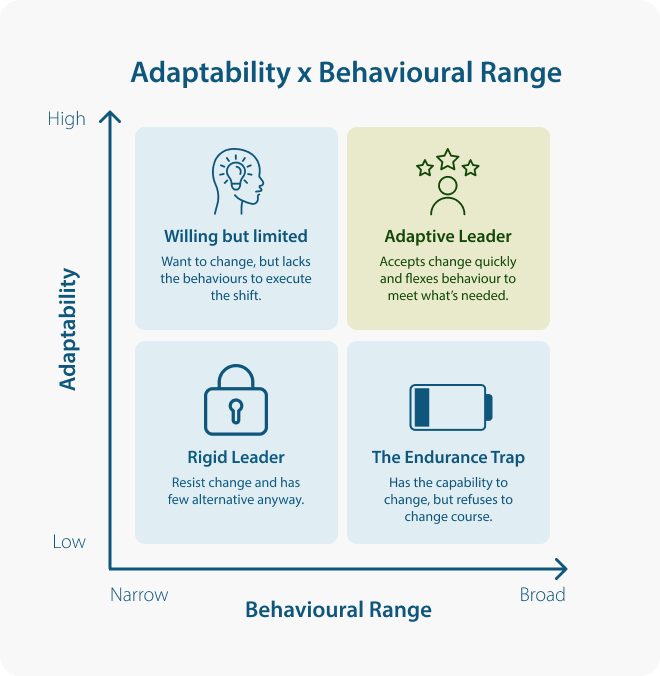
How does pressure affect behavioural range?
Here is the part most organisations miss. Sustained pressure does something very specific to behaviour. It narrows it.
"Under sustained pressure we overuse our strengths and our behaviour narrows," Thompson says. "We become the worst version of ourselves." The naturally decisive leader tips into control. The careful one freezes. The warm one goes quiet. And the quality of thinking narrows right along with it. "Leaders start to confuse speed with clarity," he adds. "Making a decision feels like progress, but often it's just being reactive."
The naturally decisive leader tips into control. The careful one freezes. The warm one goes quiet. And the quality of thinking narrows right along with it.
None of that shows up on a project plan. It shows up in the room. And teams feel it first.
They read the shorter replies, the tighter grip, the leader who used to ask and now just tells, and they draw their own conclusions. Left unchecked, that is the point where your best people quietly start to wonder whether it is still the right place to be.
What the research reveals about behaviour
The Global Change Readiness Report 2026, a study of 880 senior HR and people leaders across 11 markets, puts hard numbers to what leaders are feeling.
Change is difficult enough. What stands out is how often organisations underestimate what is coming. Organisations experience significant change every 3.2 years on average. Before their most recent change programme, 39% of leaders expected moderate or major disruption. Once it was under way, that figure jumped to 51%.
What resilience asks of leaders
For leaders navigating change, resilience requires both: the willingness to change course and the behavioural range to lead differently when they need to.
It’s range, not grit. There is no call to toughen up and weather the storm of yet another transformation project.
It means first understanding the leadership styles you naturally reach for, and then knowing what to do with them.
"As Thompson puts it, emotional awareness has two halves. "Understanding my own emotions and understanding their impact on others. It's the second half people miss."
And that is especially difficult to see in the middle of disruption. A familiar leadership style may have served you well for years and still not be the right response to what your team needs now.
"Michelle Spirit, Director at Unify Partnership, says it’s vital to give people "the language to acknowledge and recognise their experience, so that they know they're not in trouble, but they could perform at a better level if they were better at managing that emotional response." Name it, don't shame it."
Behavioural range can be developed
Knowing your default style doesn’t mean you’re stuck with it. Leaders can learn to recognise the behaviours they naturally reach for, notice when those behaviours aren’t serving the situation, and draw on something different,
Whether that’s moving from Results Leadership to Relationship Leadership. Or Centred to Visionary.
A behavioural language for identifying these styles gives leaders something to notice, reflect on and talk about. They learn to spot the natural reliance on one style in themselves and their colleagues, rather than simply experiencing it.
That’s where programmes like Insights Discovery can give teams a shared framework for understanding these styles, alongside its leadership and change applications, Self Aware Leader and Thriving Through Change.
And the behavioural change is measurable. Across 455 learners in an Impact Study conducted in 2026, Insights recorded an average 31.7% uplift across five workplace behaviours after the programme, including a 31.4% lift in recognising that people respond differently to change and adjusting approaches accordingly.
The Global Change Readiness Report points to the same opportunity at an organisational level: support leaders in building their behavioural range and readiness, strengthening the capabilities that underpin resilience.

Want to build behavioural range in your leaders?
Knowing your default style doesn’t mean you’re stuck with it. Leaders can learn to recognise the behaviours they naturally reach for, notice when those behaviours aren’t serving the situation, and draw on something different.
With expert insight from:
Paul Thompson FCIPD, Managing Director, Westminster Associates. LinkedIn
Michelle Spirit, Director, Unify Partnership. LinkedIn
